
The distinctions between a S Corp, a C Corp, an LLC, and an LLP provide several benefits and drawbacks to each organisation.
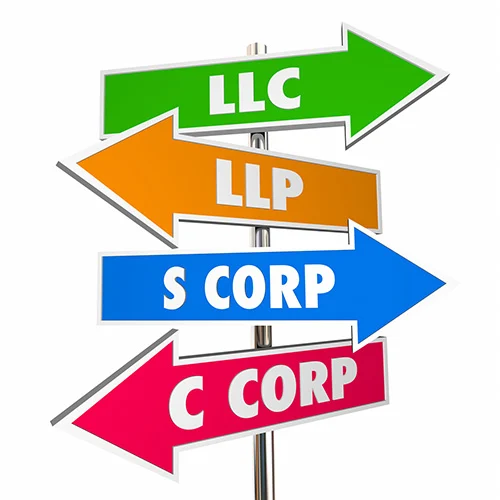
The distinctions between a S Corp, a C Corp, an LLC, and an LLP provide several benefits and drawbacks to each organisation. To choose which business structure is appropriate for your firm, you must first understand the features, advantages, and limits of each kind of organisation.
Table of Contents
S-Corporation (S Corp)
An S Corporation provides you with the same level of responsibility as an LLC. The primary distinction between the two sorts of organisations is how you will pay taxes on your revenue.
With an LLC, company revenue and costs are accounted for in the business owner’s personal tax. The corporation effectively gives you a salary via a S Corporation, which you then pay taxes on as ordinary income. Furthermore, any excess gains are deemed dividends and are taxed at a lower rate than they would be under an LLC. As a result, in certain cases, S Corporations provide considerable tax savings.
S Corporations have just one class of stock and cannot have more than 100 shareholders.
C Corporation (C Corp)
The primary distinction between a C Corporation and other forms is, once again, the variation in tax possibilities. An S Corporation and an LLC have distinct tax structures, but the owners are still responsible for paying taxes on the company’s income. Both the C Corporation and the LLC provide its owners with minimal liability protection.
There are no restrictions on the types of shares or the number of shareholders permitted in C corporations.
A firm must file Articles of Incorporation to become a C Corporation. Shareholders acquire firm shares as a kind of collateral.
Corporations benefit from preferential tax treatment when it comes to deducting costs for workplace perks such as health insurance, life insurance, and retirement packages. Because these benefits are not taxable to the employee, they are not taxed. According to the IRS’s rigorous definition of “employee,” in order for an owner to be deemed an employee, the firm must be a corporation.
Because certain banks and investors prefer to invest in corporations over LLCs, obtaining capital for a corporation may be simpler than for other forms. If you want to seek venture capitalist investment or to have an initial public offering (IPO) in the future, incorporating as a C Corporation is your best chance.
Among the benefits of incorporation are:
Personal liability insurance.
Transferring ownership is simple.
Life span is unbounded.
Tax advantages.
Easier fundraising in general.
Among the disadvantages of incorporation are:
Meetings, files, and other legal procedures, as well as bureaucracy
Expensive formation requirements.
State rules impose restrictions.
Fundraising is more challenging in various circumstances (equity capital, loan capital, etc.).
Limited Liability Corporation (LLC)
A limited liability company (LLC) is a basic business form that is appropriate for a wide range of businesses, from those with a single owner or a few workers to much bigger corporations. The primary objective of an LLC is to shield the owner from personal accountability for the company’s debts or acts. This implies that the firm is personally liable for the obligations.
An LLC is the most adaptable of all company formations when it comes to defining how it will be managed and how the owner’s financial interests will be distributed. In terms of income tax, it may even elect to be treated as a C corporation or a S corporation rather than as a sole proprietorship or partnership.
Because of its flexibility, the LLC form is best suited for owners who want greater control over their company’s administration and taxes.
Limited Liability Company (LLP)
A limited liability partnership (LLP) and an LLC have certain fundamental characteristics, but the primary distinction is one of responsibility. In certain situations (for example, fraud), the owners of an LLC may be held accountable for the company’s acts. Even if it was your partner who perpetrated the fraud, as the owner of the firm, you may still be held accountable. An LLP may defend against this kind of event since the structure restricts each partner’s responsibility.
The number of partners who may be engaged in an LLP is unrestricted. Partners might be generic or specific.
Copy and paste this <iframe> into your site. It renders a lightweight card.
Preview loads from ?cta_embed=1 on this post.